


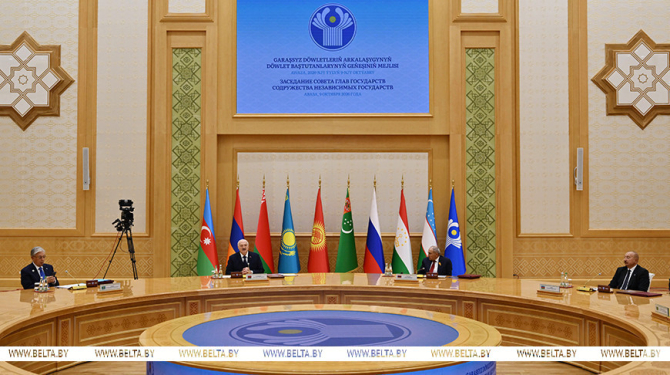
AWAZA, 9 October (BelTA) – The countries of the Commonwealth of Independent States need to take steps toward strengthening their unity, and expanding economic cooperation should be the priority in this regard, Belarusian President Aleksandr Lukashenko said at the CIS summit in Turkmenistan, BelTA has learned.
The head of the Belarusian state expressed his personal position on this issue at the conclusion of the official part of his speech at the summit.
“It is good that we meet, that we talk, that we look each other in the eye and make statements. Our people at home need to see that. But let us also take further steps toward closer unity. And what will secure that unity above all is the economy. It means prosperity and strength for our states. Then there will be less talk about independence and preserving borders and so on. We need to strengthen our economies. There is serious work ahead of us. And we are ready to play our part in every way,” the Belarusian leader said.
“As I often say, I have been president for a long time. Today we approved the agenda, based on what we can do. But look at today’s decisions. What is missing? Action on the very goals we keep talking about: the well-being of our peoples and states. Where is that in this agenda? And so it goes, year after year,” the president noted.
Aleksandr Lukashenko noted that the Commonwealth today does not consist of the 15 republics that were once part of the Soviet Union. Nevertheless, it comprises nine states, including powerful and large ones with substantial resources and capabilities. Among them are Russia, Kazakhstan and Azerbaijan, which could serve as serious locomotives of development within the CIS. “I am not diminishing in any way the role of Uzbekistan, Turkmenistan or other states,” the head of state noted.
“But we can do it! So why, in the end, are there no such initiatives that would preserve the unity of our nine states?” Aleksandr Lukashenko asked. “Somewhere a union has emerged, somewhere else a union has emerged, and so on, not to name them. Thank God, we are preserving our unity. It is fragile, but we are preserving it.”
The president recalled that recently, when meeting in Minsk with the heads of government of the Eurasian Economic Union countries, he had spoken about growing competition in the world and the fact that “no one is waiting for us anywhere.” “This is especially and above all has to do with the economy. So let us preserve our [common] space. But to preserve it, we must increase, for each state, the value of belonging to this organization. Do we do this every year? No,” Aleksandr Lukashenko stated.
He emphasized that not only the CIS Executive Committee, but above all the large and powerful countries with resources, must consider adopting more serious decisions.
“First of all, from a purely human standpoint, I see a role for the three or four states I have just named. Rich, very wealthy states. They should go first and lead our organization. In any organization, in any team, you need those who go ahead. You can call them leaders. Where are they? We need to move forward,” the president urged.
He referred to the statement by the heads of state on the preservation of historical memory being adopted at the current summit: “If we keep gathering like this and adopting statements only about historical memory and its preservation… Well, we will preserve it. We have already drilled that into everyone’s head. If someone wants to, they will preserve it. If they do not want to, they will not, regardless of these statements.”
“That is why we need action in the economic sector. More serious one,” the Belarusian leader emphasized.
In this connection, he welcomed the statements made at the summit by the leaders of Azerbaijan and Armenia about expanding logistics capabilities for cargo transport.
Turning to the role of large, wealthy states in the organization, the president acknowledged that more serious action in promoting economic cooperation could, in one way or another, affect their interests to some extent. “Something has to be sacrificed,” he observed.
“We need to single out these areas and act [on deepening economic cooperation]. If we do not act, we will gradually be pulled apart into different organizations. Again, I will not name the names. We know perfectly well who has set their sights on the states of our organization,” the Belarusian leader concluded.


